
 My Agento


Icicles and Snow Falling From Roofs: Who Pays for a Damaged Car or an Injury and What Insurance Covers
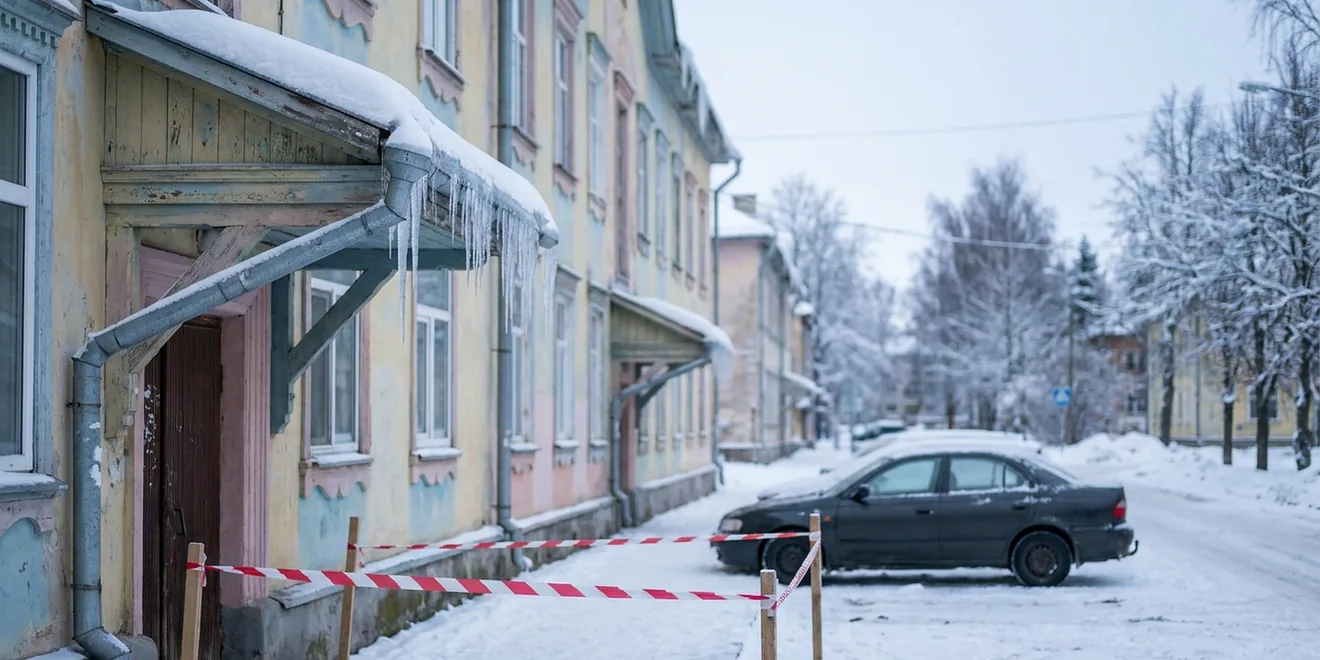
After the first heavy snowfall and thaw, warning tape goes up around buildings, but not always in time. Snow sliding off a roof can dent a car roof, and a falling icicle can seriously injure a person. This guide explains who is responsible for snow and icicles on a roof in Latvia, what fines apply for not clearing them, who pays for a damaged car or an injury, and how insurance helps both the injured party and the building owner.
Who is responsible for snow and icicles on a roof
Section 1084 of the Latvian Civil Law requires every building owner to keep the building in a condition that cannot harm neighbours, passers-by or its users. In winter, that includes clearing snow and icicles in time.
In an apartment building, sanitary maintenance is a mandatory management task (Section 6 of the Residential Property Management Law, Dzīvojamo māju pārvaldīšanas likums). Cabinet Regulation No. 906 requires snow and ice, including icicles, to be cleared from the facade and roof in winter so that they do not fall from the roof, cornices, drainpipes, loggias and balconies, and dangerous spots to be fenced off in good time (points 6.2 and 6.3). The building manager makes sure this is done. If management is outsourced to a management company, it answers to the owners under the law and the management contract, while overall responsibility for managing the building stays with its owners (Sections 9 and 16 of the law).
For a private house, shop or office building, the person responsible is usually the owner or another lawful possessor. If the building is leased, the lease often decides who clears the roof, so it is worth checking in autumn.
Municipalities spell out these duties in their binding regulations. In Riga, these are the Riga City Municipality binding regulations No. RD-24-270-sn on maintaining territory and buildings. They require the owner, lawful possessor or building manager to clear snow, ice and icicles from balconies, loggias, roofs and other structures where falling snow or ice could endanger pedestrians and vehicles. The danger zone must be fenced off while the work is done, and afterwards the pavement must be cleaned by 7:00 if the work was done at night, or within an hour if during the day (point 4.3). The same regulations require pavements and footpaths by the building to be cleared of snow and gritted every day by 8:00 and again during the day if needed (points 4.1.4 and 4.2.3). So if a passer-by slips on an uncleared pavement outside a building, the question of liability often goes to the same owner or manager. Other municipalities may have different rules, so check your own.
Fines for icicles left on the roof
In Riga, breaching points 4.1 and 4.3 (icicles and snow on structures, your own property) can lead to a warning or a fine of up to EUR 350 for individuals, and a fine of up to EUR 1,400 for companies (point 22 of the regulations). If the delay directly endangers people's lives, health or property, the municipal police can also order the work to be done immediately (point 20). Keep in mind that the fine goes to the municipality, not to the injured person. Compensation for damage is a separate matter.
If an icicle or snow falls on your car
OCTA does not help here, because the damage was not caused by a vehicle. There are two routes.
- A claim against the party responsible. Sections 1635 and 1779 of the Civil Law require whoever caused the damage through an act or omission, and can be held at fault for it, to compensate it. Send a written claim to the building owner or manager. Management companies and businesses often insure their civil liability, in which case their insurer handles the claim.
- Your own KASKO. If your policy includes the falling objects or natural hazards risk, KASKO can pay for the repair minus the deductible. Once it pays, the insurer takes over your claim against the party at fault (Section 45 of the Insurance Contract Law) and deals with it directly. This is usually faster than waiting for the party at fault to accept liability.
Some KASKO terms require you to notify the police if objects falling from someone else's building damaged the car, so check your terms before you drive away. If you do not have KASKO or your policy does not cover falling objects, you can request KASKO offers and compare cover.
Your own conduct matters too. If the area was fenced off and the warning was clearly visible, but the car was still parked right under the roof edge, the responsible party may argue that part of the blame lies with you, which can reduce the payout. During a thaw, it is better not to park under the eaves.
If a person is injured
If an icicle or a chunk of snow injures a passer-by, call 112 first. Section 2347 of the Civil Law requires anyone who causes bodily injury through an unlawful act for which they are at fault to pay treatment costs and, at the court's discretion, lost earnings and compensation for non-material harm. These claims, too, are usually handled by the civil liability insurer of the building owner or manager. If the injured person has their own accident insurance, it pays under its own terms regardless of who is at fault.
The Civil Law also has special rules for damage caused by something thrown or poured onto the street, or by an improperly secured object falling from a house (Sections 2358 to 2362). Such a claim is brought against whoever lives in or holds the building or the relevant part of it, and it expires after one year. Whether these sections apply to a particular icicle is for the court to decide, so do not delay your claim.
If snow from your roof causes damage
If you own a house and snow slides off your roof onto a neighbour's car or injures a passer-by, you are the one who has to answer for it. This is where civil liability cover helps, which can be added to house insurance and apartment insurance. It covers damage to third parties up to the limit in the policy. For businesses that own or rent a shop, office or warehouse, similar protection comes from business civil liability insurance.
Damage to the building itself, such as a roof caved in by the weight of snow or a torn-off gutter, often falls under the natural hazards risk in home insurance, but the conditions vary. For example, one insurer's terms cover damage from the weight of snow and ice if it happened during or right after heavy snowfall and the snow could not reasonably have been cleared, while losses caused by not clearing snow from the roof are excluded. Another insurer's terms define continuous snowfall as the snow cover growing by at least 100 mm within 24 hours. Before winter, check whether your policy includes natural hazards and civil liability, and what the liability limit is.
What to do right after an incident
- If anyone is hurt, call 112. If property is damaged, call the police so the incident is recorded.
- Photograph the damage, the fallen ice or snow, the roof edge, the building's address and whether there was any fencing or warning signs. Note the time and the weather.
- Write down witnesses' contact details.
- Find out who manages or owns the building and send a written claim. Ask who their civil liability insurer is.
- If you are using KASKO, report the incident as soon as possible and do not repair the car before the insurer has inspected it.
- Keep receipts for treatment, towing and other expenses.
If you are not sure which policy covers your situation, Agento's brokers can help you go through the terms and, if needed, compare offers from several insurers.