
 My Agento


Agreed Statement: How to Fill It In Correctly
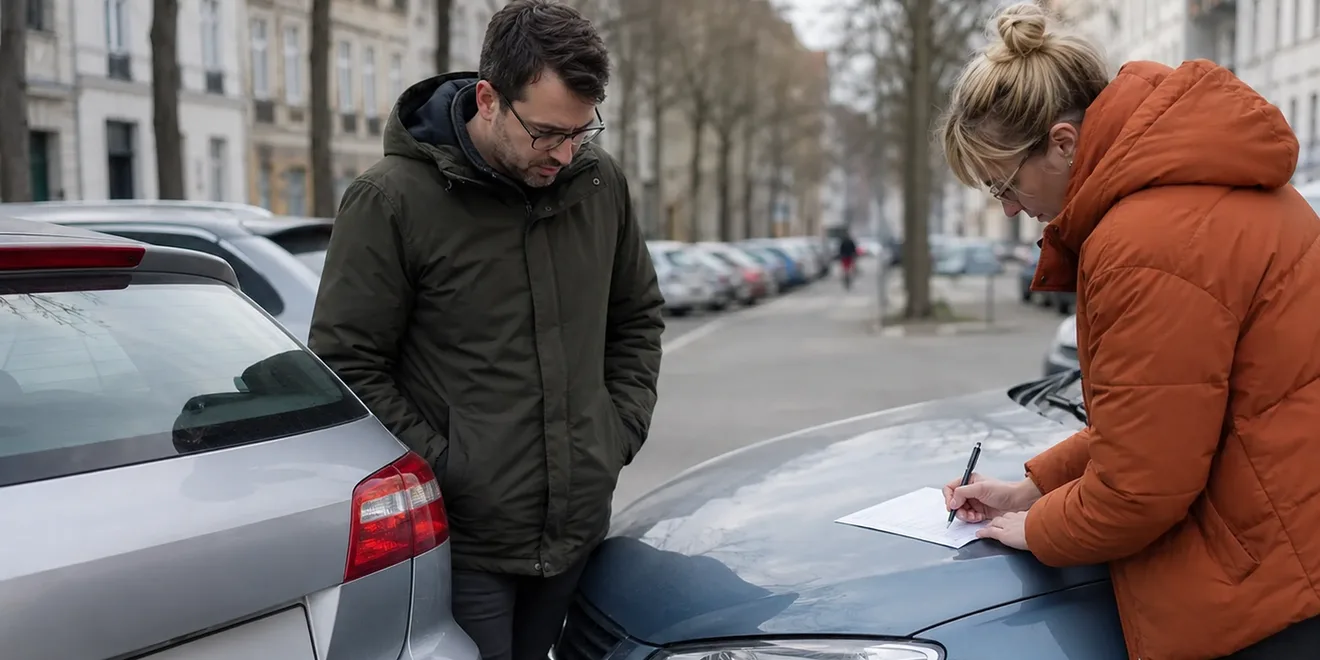
A minor collision in a car park or at a junction is unpleasant, but it does not always mean waiting for the police. If the accident is light and both drivers agree on what happened, the situation can be documented with an agreed statement right at the scene. In this article we explain when this is allowed, how to fill in the form correctly and what to do afterwards so that the claim process goes smoothly.
What is an agreed statement?
The agreed statement is a form of a single European standard that both drivers involved in a road accident fill in together. It records the place and time of the accident, the vehicles involved, the visible damage, the circumstances and a sketch of the collision. Once completed and signed by both drivers, the form is the basis for an OCTA insurance claim. The paper form is printed on self-copying paper: by filling in one copy you automatically produce a second one, and each driver keeps their own.
When may an agreed statement be used?
An agreed statement may replace calling the police only when all of the following conditions are met at the same time:
- only two vehicles are involved in the accident;
- no people have been injured;
- no third-party property has been damaged, for example a fence, a lamp post or a third car;
- both drivers agree on all the essential circumstances of the accident;
- neither vehicle has damage that prevents it from lawfully continuing in road traffic.
If even one condition is not met, for example the other driver disputes what happened or someone is injured, you must call the police on 110 or 112.
How to fill it in: step by step
- Step 1. Stop, switch on your hazard lights and make sure all the conditions listed above are met.
- Step 2. Fill in one form for both vehicles. Use a ballpoint pen so the text imprints clearly on the second copy.
- Step 3. State the place, date and time of the accident, as well as the names and contacts of any witnesses.
- Step 4. Enter the details of both vehicles: make, registration number, insurer and OCTA policy number.
- Step 5. Enter the details of both drivers: name, surname, personal identity number, contact details and driving licence data.
- Step 6. Tick the visible damage and the circumstances of the accident in the relevant boxes and state the number of boxes ticked.
- Step 7. Draw the sketch: the position of the vehicles at the moment of the collision, not after it, plus the road edges, the centre line, road signs and traffic lights.
- Step 8. Both drivers sign the form and each keeps their own copy. No corrections may be made after the form has been completed.
The agreed statement can also be completed electronically in the LTAB OCTA mobile app or via WhatsApp. A statement filled in through the app is equivalent to the paper form, and the data is passed to the insurers electronically. Detailed instructions for the form are available on our agreed statement page.
Common mistakes
- one or both drivers' signatures are missing - without them the document has no force;
- the sketch shows the vehicles' position after the accident instead of at the moment of the collision;
- a personal identity number, policy number or contact details are missing;
- the number of ticked boxes is not stated, which makes it possible to dispute the content later;
- corrections were made to the form after it was completed - this is not allowed;
- the statement was filled in when the police should have been called instead.
What to do after filling it in?
The driver who caused the accident must submit their copy of the agreed statement to their insurer within 10 days of the accident. The injured party also submits their copy to the at-fault driver's insurer when filing the claim. If they fail to do so and ignore the insurer's reminder as well, the insurer may recover the paid compensation from them through recourse. The injured party has the right to submit a claim for vehicle damage to the at-fault driver's insurer within one year, and for personal injury within three years of the accident. How to file a claim with each insurer is described step by step in our claims section.
One more thing: an agreed statement only helps when both vehicles have a valid OCTA policy. You can conveniently check and arrange OCTA online in our OCTA calculator, comparing offers from several insurers.