
 My Agento


Heating Season: Chimneys, Heaters and What Home Insurance Covers
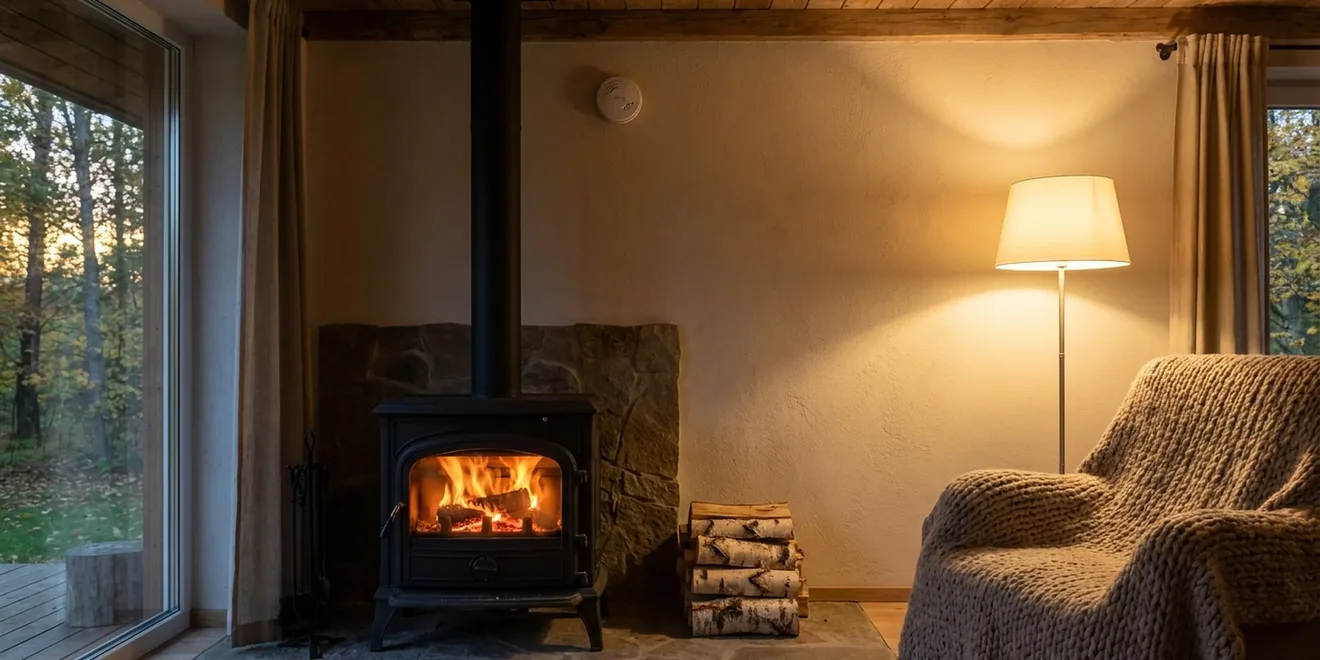
With the first cold nights, stoves, fireplaces and saunas are lit again, and electric heaters come out of the closet. Cleaning the chimney or testing the smoke detector now becomes a money matter too: if a fire starts because fire safety rules were ignored, the insurer may reduce or refuse the payout. General fire causes are covered in our article on fire safety and financial risks; here the focus is the heating season.
When to clean the chimney
The rules come from Cabinet of Ministers Regulation No. 238, the Fire Safety Regulations. The key date is November 1: by then, chimneys of solid and liquid fuel heating appliances must be cleaned. If a solid fuel appliance does not store heat for longer than three hours, the chimney must be cleaned once more during the season, between November 1 and March 1. Not sure which group your stove or sauna stove falls into? Ask a chimney sweep.
- Gas heating equipment is cleaned, serviced and inspected at least once a year, unless the manufacturer says otherwise.
- The technical condition of solid and liquid fuel equipment and its chimney is inspected every five years.
- Burning out soot to clean a chimney is prohibited.
A cleaning report records the date, the sweep, their qualification and the conclusion. A homeowner who cleans a solid fuel appliance personally may skip it, but after a fire, a sweep's report and proof of payment are the simplest evidence. Keep them with your policy.
Note that a new Fire Safety, Firefighting and Rescue Work Law took effect on November 13, 2025, and likumi.lv states that Regulation No. 238 expires on January 2, 2027. So this year's November 1 deadline still follows Regulation No. 238, but the requirements may change from early 2027, in the middle of the heating season, so watch for the new rules.
A smoke detector on every floor
Since January 1, 2020, every private house and apartment must have an autonomous fire detector that reacts to smoke, at least one on each floor. A two-story house therefore needs at least two. The State Fire and Rescue Service (VUGD) reminds residents that, depending on the model, the test button should be pressed weekly or monthly. The start of the season is a good time to test it and change the battery.
Stoves, fireplaces and sauna stoves
Wood-burning sauna stoves and fireplaces are solid fuel appliances too, so the same prohibitions apply:
- do not use a damaged stove or chimney, and do not overheat it;
- do not leave a lit stove unattended unless the manufacturer allows it;
- keep firewood and other combustibles at least 0.5 m from the stove and 1.2 m from the front of the firebox;
- do not use flammable liquids for lighting, except products made for that purpose;
- do not burn logs longer than the firebox;
- store ash in a non-combustible container outside the building.
A combustible floor in front of the firebox, such as wooden boards, must be covered with non-combustible material extending at least 150 mm to the sides and 300 mm to the front.
Electric heaters and extension cords
In apartments, portable heaters deserve attention. The rules prohibit damaged or homemade electrical devices, wires with damaged insulation, and extension cords coiled on a reel or in loops unless the manufacturer allows it. VUGD advises not to cover heaters or dry clothes on them. If a heater must run through an extension cord, unwind it fully and never hide it under a rug.
Carbon monoxide: an invisible risk
Carbon monoxide is colorless, odorless and tasteless, and in high concentrations it can kill within minutes. The Consumer Rights Protection Center (PTAC) names untested gas boilers, fireplaces and stoves as risk sources, along with closing the stove damper too early. The fire safety rules do not require a carbon monoxide detector in an ordinary home, but PTAC calls it one of the most effective protections. Look for the CE marking and compliance with the EN 50291-1 standard.
What home insurance covers and when payouts shrink
Fire is a core risk in both house insurance and apartment insurance. Building cover can include the chimney, stove and fireplace.
The Insurance Contract Law states that an insurer may not pay a person whose intent or gross negligence caused the insured risk, and the actions of household members are treated as the insured's own. For failing obligations after an incident, the law allows refusal for gross negligence and a reduction of no more than 50 percent for slight negligence. Insurers' terms usually list safety requirements separately, such as following fire safety rules, cleaning chimneys and using heaters as instructed. If a breach contributed to the loss, the terms allow the payout to be cut by up to 50 percent or refused.
There is an upside too: some terms pay fire losses with no deductible if working smoke detectors were installed. The insurer must prove the grounds for any refusal or reduction, but a sweep's report and the detector receipt help avoid the dispute. Before renewing, compare how insurers word safety requirements and deductibles; an Agento broker can help you request offers and spot the differences.