
 My Agento


Slippery roads in Latvia: who pays for the damage when your car skids on ice
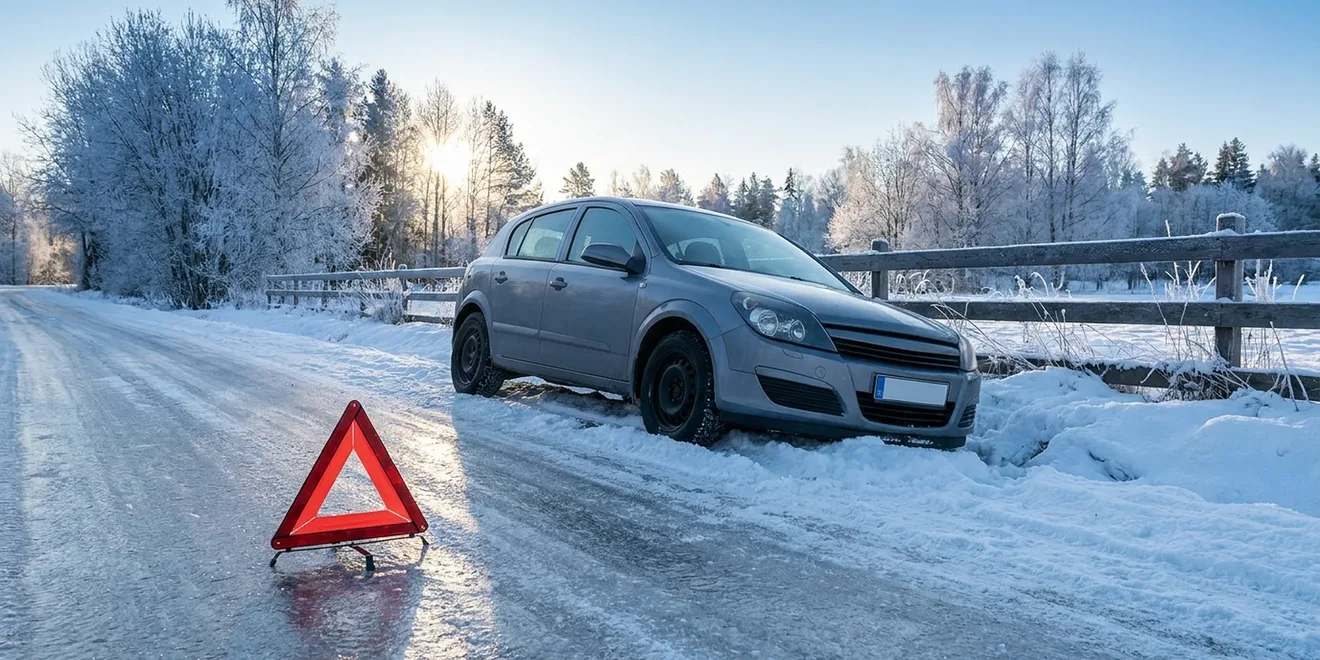
The first frost often arrives while drivers still drive as if the asphalt were dry. Black ice in the morning is hard to spot. This article covers what comes after a skid: who pays for the damage in four typical scenarios.
The basic rule: a slippery road does not excuse you
Point 99 of the Latvian Road Traffic Regulations (Ceļu satiksmes noteikumi) requires drivers to stay within speed limits while taking road and weather conditions into account. Point 100 requires slowing down or stopping when a noticeable hazard appears, and point 105 requires enough distance to avoid a collision if the vehicle ahead brakes. So "my car just slid" is no excuse.
Section 2347 of the Civil Law also treats transport as a source of increased danger: whoever operates it must compensate the damage caused, unless they prove force majeure or the injured party's own intent or gross negligence.
Keep two policies apart. OCTA, the compulsory motor liability insurance, covers damage you cause to others, while Section 35 of the OCTA Law excludes property damage suffered by the owner of the at-fault vehicle. Only KASKO can cover repairs to your own car.
Scenario 1: you slide alone into a fence, a pole or a ditch
If you end up in a ditch or hit a tree, only KASKO pays for your car, and only if the policy includes the road accident risk; the deductible is subtracted. Without KASKO, the repair is on you.
If you damage someone else's fence, a lamp post, a guardrail or a road sign, that is third-party property. Section 25 of the OCTA Law includes damage to roads, road structures, buildings and other property, so your OCTA pays. Point 39 of the Regulations then requires you to stay at the scene, switch on the hazard lights, place the warning triangle and notify the police. If the police are not notified through ill intent or gross negligence, Section 35 of the OCTA Law says such property damage is not compensated.
If only your car was involved, nobody was hurt and no one else's property was damaged, point 43 allows you to leave without calling the police. Your KASKO terms may still require the incident to be recorded, so check them first.
Scenario 2: you slide into another car
If you cannot stop in time on ice and hit the car ahead or an oncoming car, you will usually be found at fault, because your speed or distance did not suit the conditions. Your OCTA covers the other party's losses within the limits set by law: up to EUR 1,300,000 for property damage and up to EUR 6,450,000 for bodily injury. Your own car is again a KASKO matter.
Fault is not always 100 percent: under Section 31 of the OCTA Law, insurers assess each party's liability, so if the other driver also broke the rules, fault may be shared, and the other driver's OCTA then covers part of your car's damage in proportion to their share.
If nobody was hurt, no third-party property was damaged, both cars can be driven and the drivers agree on what happened, point 40 of the Regulations allows you to settle the incident without the police. Our guide on how to fill in the agreed statement explains the steps. An at-fault driver who is not claiming compensation must submit the completed form to their own OCTA insurer within 10 days.
Scenario 3: a skidding car hits you
This time the at-fault driver's OCTA covers your losses. You file the claim with the insurer of the at-fault vehicle's owner and attach the agreed statement or police documents. If the insurers have agreed on direct claims settlement, your own OCTA insurer may handle the claim instead.
Keep the damaged car as it was after the accident until the damage is recorded, as the law requires. Photograph the cars, the damage and the road surface, and note witnesses' contacts.
Scenario 4: is a poorly maintained road to blame?
Section 1635 of the Civil Law lets an injured person claim compensation from whoever caused the harm, to the extent that person can be held at fault. In principle, this also applies to a road owner or maintainer. In practice, it is hard: you must prove that the road was not maintained as required, that a specific party was responsible and that this caused the crash, while point 99 on adjusting speed to conditions will always be the counterargument. If you still want to try, document the road condition and time, keep the police documents and talk to a lawyer. No outcome is guaranteed.
What to check before the first frost
- Whether your OCTA is valid and when it expires. Before it runs out, you can compare offers in the OCTA calculator.
- Whether your KASKO covers accidents where you are the one at fault, and how high the deductible is.
- Whether your car has winter tires. Point 219 of the Regulations requires them from December 1 to March 1, but ice can come earlier. Read more about winter tire requirements in Latvia.
- Whether there is a blank agreed statement form in the glove box.
If you do not have KASKO or your policy no longer fits, you can request KASKO offers: Agento, an insurance broker, compares terms, deductibles and coverage from several insurers so you can choose with confidence.