
 My Agento


Winter tyres in Latvia: dates, requirements and fines
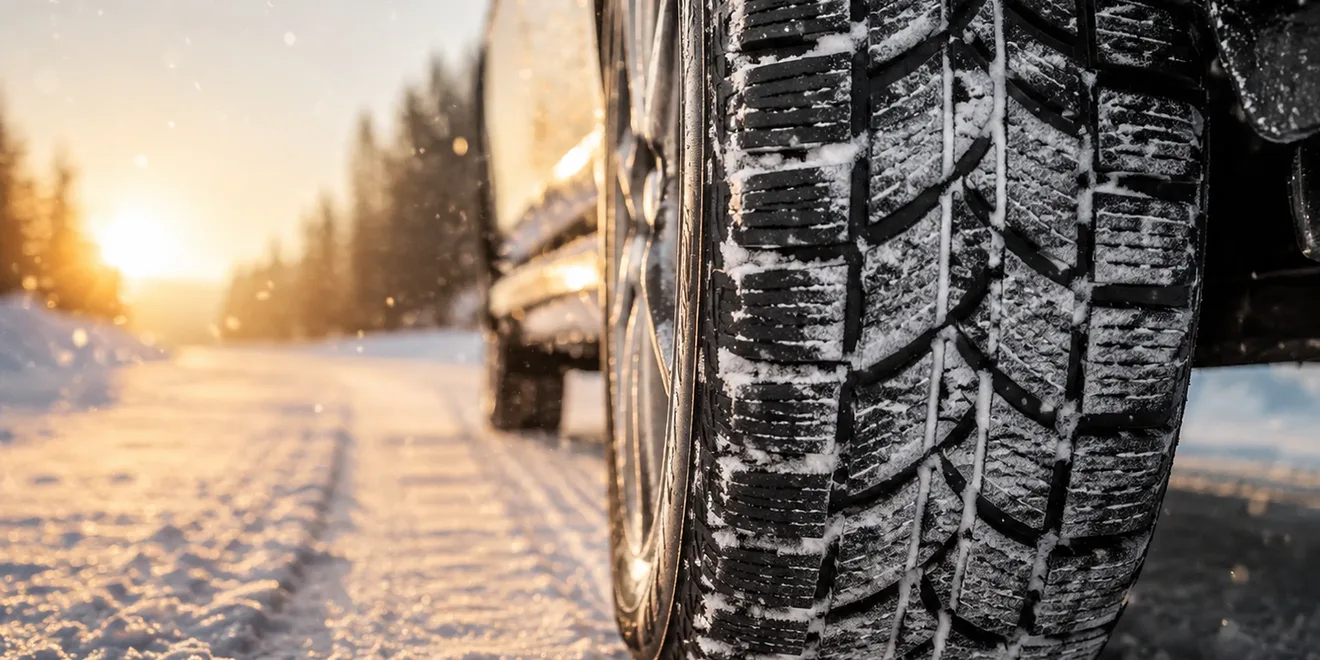
Winter tyres in Latvia are not just common sense: the dates and markings are set by the Road Traffic Regulations and the roadworthiness rules, and breaking them means fines. Since the 2024 winter season the rules are stricter - an M+S marking alone is no longer enough. Here is what you need to know before the 2026/2027 winter: dates, markings, tread depth, fines and how your tyres can affect OCTA and KASKO claims.
Key points at a glance
- from 1 December to 1 March, winter tyres are mandatory for cars and buses with a gross weight of up to 3.5 tonnes;
- winter tyres must carry the mountain and snowflake symbol (3PMSF) - tyres marked only M+S do not comply in winter;
- the minimum tread depth for winter tyres is 4 mm;
- studded tyres are prohibited from 1 May to 1 October;
- driving without winter tyres means a 30 EUR fine, and if the tyres played a part in an accident, the OCTA insurer may claim back what it paid out.
From which date winter tyres are mandatory
Paragraph 219 of the Road Traffic Regulations (CSN) states that from 1 December to 1 March any car or bus with a gross weight of up to 3.5 tonnes must be fitted with tyres designed for winter conditions. This covers passenger cars as well as vans and small buses. The rule applies whatever the weather: even on dry roads above zero in early December, winter tyres must be on.
Lorries and buses over 3.5 tonnes need no winter tyres, but face stricter winter tread rules (see the table below). Trailers are not covered by the winter tyre rule either, but studded tyres are banned in summer on both the car and its trailer.
In practice, change tyres in November: the first ice often comes in late October, and the first snow brings queues at tyre shops.
Winter tyre calendar 2026/2027
| Period | What applies |
|---|---|
| After 1 October | Studded tyres may be fitted |
| 1 December - 1 March | Winter tyres with the mountain and snowflake symbol are mandatory, minimum tread 4 mm (vehicles up to 3.5 t) |
| 1 December - 1 March | On expressways (road sign 552) the speed limit for cars is 110 km/h instead of 120 km/h |
| From 2 March | Tyres marked only M+S are allowed again, minimum tread 1.6 mm |
| 1 May - 1 October | Studded tyres are prohibited and must be removed before 1 May |
Mountain and snowflake: how to recognise a compliant winter tyre
Since 1 December 2024, only tyres designed for snow and ice and marked with the mountain and snowflake symbol - a three-peak mountain with a snowflake inside - count as compliant in winter. Internationally it is known as 3PMSF or the Alpine symbol, and it means the tyre has passed a standardised snow test.
The M+S inscription (Mud and Snow) guarantees nothing on its own: manufacturers can apply it based on the tread pattern alone, without a test. Tyres marked only M+S may be used from 2 March to 30 November. The same goes for all-season tyres: they are only allowed in winter if the sidewall also shows the mountain and snowflake symbol.
Other rules to note:
- tyres with and without the mountain and snowflake symbol must not be mixed on one axle;
- on a vehicle up to 3.5 tonnes, the tyres on one axle must be of the same make, brand and tread pattern;
- studded and non-studded tyres must not be used at the same time;
- tyres must be fitted according to the marked direction of rotation or side (inside and outside).
Studded or non-studded tyres
Studded tyres may not be used in Latvia from 1 May to 1 October, because they damage the road surface. Studs grip much better on ice and packed snow, but lose their edge on dry or wet asphalt and are noisier. Non-studded, or friction, tyres are quieter and suit cities, where streets are cleaned and gritted regularly. On icy rural roads or early-morning drives, studs are often the safer choice.
Only winter tyres may be studded, and the number of studs in the tyres of one vehicle must not differ by more than 20%. On a passenger car, studs may protrude by no more than 2 mm on average.
Tread depth and tyre age
In winter the tread on the winter tyres of a vehicle up to 3.5 tonnes must be at least 4 mm deep. Heavy vehicles have different limits:
| Vehicle | 1 December - 1 March | Rest of the year |
|---|---|---|
| Vehicles up to 3.5 t | 4 mm | 1.6 mm |
| Lorries over 3.5 t | 2 mm | 1.6 mm |
| Buses over 3.5 t | 3 mm | 2 mm |
4 mm is the legal minimum, not a comfort zone: the shallower the tread, the worse the tyre clears slush and the longer the braking distance. If your tread is already close to 5 mm, buy new tyres this autumn, as it may drop below 4 mm by mid-winter. Measure with a tread depth gauge at several points across the tyre, because wear is often uneven.
Latvia has no legal age limit for tyres, but CSDD advises against winter tyres older than 5-6 years: rubber hardens over time and loses grip in the cold. The last four digits of the DOT code on the sidewall show the date of manufacture - for example, 4122 means week 41 of 2022. Tyres must not have cuts exposing the cord, bulges or age cracks.
Fines and roadside checks
Fines for tyre offences are set by Article 71 of the Road Traffic Law (Ceļu satiksmes likums):
- driving a car or bus up to 3.5 tonnes without winter tyres between 1 December and 1 March - 30 EUR for the driver;
- driving on studded tyres between 1 May and 1 October - 30 EUR for the driver;
- insufficient tread depth or dangerous tyre damage - a warning or 15-55 EUR for the driver, 55-140 EUR for the private individual responsible for operating the vehicle, and 70-700 EUR for a legal entity.
This matters for fleet owners: the company operating the vehicle is liable too, not only the driver.
A fine is not the only consequence. At the roadworthiness test and at roadside checks, tyres that do not meet the winter requirements, or tread below 3 mm, count as a dangerous defect (rating 3). The vehicle may not be driven further until the tyres are replaced and the car is re-inspected at CSDD. Tread of 3-4 mm in winter is a major defect (rating 2), which must also be fixed.
Checklist before winter
- check that all four tyres carry the mountain and snowflake symbol;
- measure the tread - at least 4 mm, ideally with a margin;
- check the tyre age by the DOT code and look for cracks and bulges;
- check the pressure - it drops by about 0.1 bar for every 10 degrees of cooling;
- recheck the wheel bolts after the first 50-100 km;
- add winter screenwash and check the wipers, battery and lights;
- keep an ice scraper and a snow brush in the car;
- make sure your roadworthiness test and OCTA are valid and reread your KASKO terms;
- store summer tyres in a dark, dry and cool place.
Winter tyres and insurance: OCTA and KASKO
Accident risk rises in winter, so it helps to know what each policy covers and how tyres can affect a payout.
OCTA is mandatory for every vehicle and covers the damage you cause to others - the other car, injured people and damaged property. Victims are compensated even if your car was on summer tyres. However, Article 41 of the OCTA law allows the insurer to bring a recourse claim against the owner or registered keeper if, between 1 December and 1 March, the car was not fitted with winter tyres and this was causally linked to the accident. The same applies if the car had no valid roadworthiness test and the accident was linked to its technical condition. In other words, you may have to repay the amount yourself. You can compare OCTA offers with the OCTA calculator.
KASKO covers damage to your own car - for example, if it skids off the road, hits a snowdrift or a pole, or is damaged in a collision caused by its driver. The exact cover depends on the policy. Many KASKO terms require the vehicle to be roadworthy and to comply with traffic rules, so driving in winter without proper tyres may lead to a reduced or refused payout. Before winter, check the exclusions, the deductible and whether roadside assistance and glass cover are included. No KASKO yet? Fill in the KASKO application and get offers from several insurers.
If an accident happens, photograph the scene, the vehicles and your own tyres - the marking and the tread - in case the tyres are disputed later. If nobody is injured, everyone has valid OCTA and you agree on what happened, you can fill in an accident statement (saskaņotais paziņojums) without calling the police. See the step-by-step guide How to file an insurance claim.